
With the enforcement of Job Creation Law there has been a surge in the discourse on law enforcement of spatial planning. This phenomenon is not completely ended even with the issuance of Government Regulation No. 43 of 2021, which regulates the settlement of incompatibilities relating to spatial planning, forest area, permit, and/or land rights.
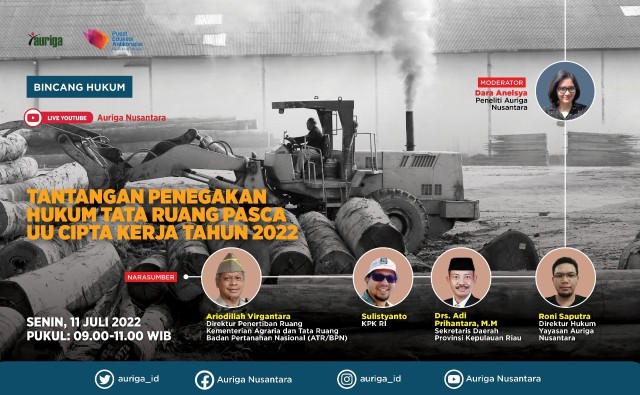
To discuss such issues, specifically with regard to the changes in the authority of spatial management by the central government and local government, and especially in relation to the handling of incompatibilities as well as the violations of spatial planning. The discussion theme is “Challenges to Spatial Planning Law Enforcement Post-Law No. 11 of 2020 on Job Creation”.
Conducted as a collaboration between Auriga Nusantara and the Anti-Corruption Learning Center Corruption Eradication Commission (KPK), the discussion was carried out online through StreamYard and streamed by way of Auriga Nusantara’s YouTube channel. Opened at 09:00, and ended at 11:00, the forum was moderated by Dara Ulfah Alnesya, a researcher at Auriga. Source persons featured were Ariodillah Virgantara, Director of Spatial Control Ministry of Agrarian Affairs and Spatial Planning/National Land Agency; Roni Saputra, Director of Law Enforcement at Auriga Nusantara; Fauziyah, from Riau Islands Public Works Agency; and Sulistyanto, Head of Capacity Enhancement and Law Enforcement and Human Rights at KPK.
Spatial planning has been a complex sector when it comes to its relation to natural resources and the environment. Accordingly, there should be a sinergic collaboration among the related parties, especially law enforcement agencies. And all the more so with the greater role of local government that has been given to enable it to support the handling of violations of spatial utilization.
Ariodillah Virgantara agreed with that point of view. He then explained the implementation of Government Regulation No. 43 of 2021 with regard to the handling of incompatibilities relating to spatial planning law. He identified four parts the regulation actually rules. Firstly, the settlement of regional borders. Secondly, the settlement of incompatibilities in relation to province spatial planning, regency/city spatial planning, forest area, permit, concession, land rights, and/or management rights. Thirdly, the settlement of incompatibilities between Marine Spatial Planning, Zoning Plan of the National Strategic Areas, Zoning Plan of Inter-Region Areas, and/or Coastal Area and Small Islands Zoning Plan and the permits regarding activities which utilize marine space. Fourthly, about institutions and management.
The administrative sanction applied to violations, as stipulated in Law No. 11 of 2020 and Law No. 26 of 2007, is aimed at giving a deterrent effect to spatial violations. “In the hope that there will be orderly spatial utilization,” he said. The latest regulation, according to him, admittedly stressing more on imposing administrative sanctions. Only if in reality the administrative sanctions cannot get the local government support or the violators do not have good intentions, then criminal prosecutions will be taken.
Subsequently, Roni Saputra elaborated that the law enforcement stipulated in Law No. 26 of 2007 jo. Law No. 11 of 2020 uses a concept of external cumulation, that is two sanctions can be applied to one act, either administrative or criminal sanction. It is not elucidated in both regulations which sanction is given first. Meaning, “The implementation of external cumulation does not use the concept, or based on, ultimum remedium,” he said. This also means that administrative sanction and criminal sanction can be applied simultaneously.
He asserted that the concept needs to be adopted in Law No. 26 of 2007 as well as post-revised Job Creation Law. Because Job Creation Law does not explicitly, nor directly, state the use of the ultimum remedium concept, especially in relation to spatial planning. “The legislators did not affirm as such,” he said, whilst emphasizing that this is the lawmakers’ authorities, not the executants of the law.
Fauziyah, in her presentation, laid out the strategic condition of Riau Islands Province, which 90 percent of its area is sea, and only 4 percent is land. In such conditions, the challenges the government of Riau Islands Province faces with regard to spatial planning law enforcement, according to her, “are still struggling with the regulation aspect”, either on planning, utilization, or institution involvement in the management of space utilization.
As for the legal aspect, currently the regional regulation on spatial planning of Riau Islands Province is still undergoing a revision. The applicable rule is Regional Regulation No. 1 of 2017.
She revealed, with regard to spatial planning cases, of the 36 that have been audited, there will be sanctions imposed. “There is also a location that might be indicated as a crime,” she said.
The other thing she presented is that there is an expectation that the personnel of civil servant investigators in Riau Islands Province can be added. She admitted that, in fact, the province has proposed five staff to be trained as civil investigators. “But the training and education has been canceled,” she said.
According to her, currently there are only two civil investigators in Riau Islands Province, one at the Inspectorate and one at the Public Works Agency. Therefore, the province needs the support from various parties in order to enforce the law, maximize the institutions, and start the making of basic regulations so that the imposition of sanctions, penalties, and all are ready.
Lastly, Sulistyanto explained about the process of coordination and collaboration in spatial planning law enforcement. KPK, according to him, is very concerned with regard to the natural resources issues that encompass spatial planning. And it has been the focus of corruption eradication efforts since 2009 until currently, through prosecution as well as prevention.
He asserted that collaboration in natural resources and environment law enforcement has been urgent as what has been done so far has yet to give a deterrent effect. The law enforcements have not been able to return the state losses caused by the crimes. In fact, the law enforcements have not been able to restore the environmental damages caused by the crimes.
The expectation is that the collaboration and coordination can be done among the law enforcement agencies, so that a crime case can be handled effectively. The hope is that collaboration and coordination in natural resource law enforcement can be enhanced and encouraged to be adopted as the way to manage natural resources for the greater good of the people.
Time and Media
Day/Date: Monday/ July 11, 2022
Time: 09.00-11.00
Media: Auriga Nusantara’s Youtube channel
Presentations
“Implementation of Government Regulation No. 43 of 2021 Regarding Incompatibilities and Violations of Spatial Planning Law Enforcement”, Ariodillah Virgantara (Director of Spatial Control Ministry of Agrarian Affairs and Spatial Planning/National Land Agency):
https://auriga.or.id/resource/reference/implementasi_pp_nomor_43_tahun_2021.pdf
“Law Enforcement of Spatial Planning Violations Post-Enactment of Job Creation Law”, Roni Saputra (Director of Law Enforcement at Auriga Nusantara):
https://auriga.or.id/resource/reference/penegakan_hukum_pelanggaran_tata_ruang.pptx
“Challenges of Regional Governments in Spatial Planning Law Enforcement Post-Job Creation Law”, Fauziyah (representative of Riau Islands Public Works Agency):
https://auriga.or.id/resource/reference/kendala_penegakan_hukum.pptx
“Coordination and Collaboration in Spatial Planning Law Enforcement”, Sulistyanto (Head of Capacity Enhancement and Law Enforcement and Human Rights at KPK):
https://auriga.or.id/resource/reference/korlab_penegakan_hukum_tata_ruang.pdf