
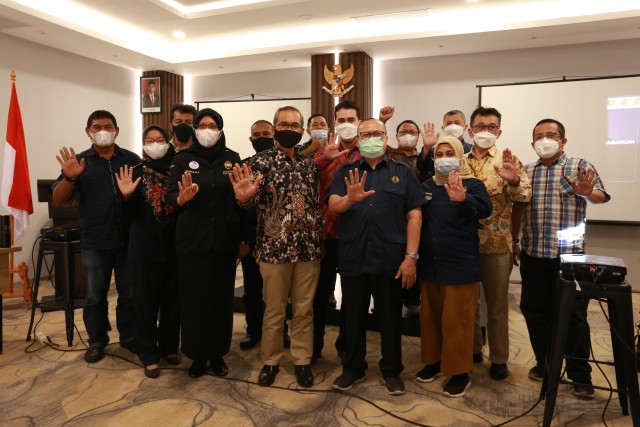
In the morning of November 10, 2021, a team of 14 people with backpacks in their hands were about to embark upon a speedboat from Ternate’s landmark Dermaga Resident port to the town of Sofifi. The team—made up of personnels from the Corruption Eradication Commission (KPK); Directorate General of Taxes Regional Office for North and Central Sulawesi, Gorontalo, and North Maluku; the Ministry of Environment and Forestry Law Enforcement Center for Maluku-Papua Region; and the Marine Affairs and Fisheries Office of North Maluku—had an inspection to PT Indonesia Weda Industrial Park (IWIP) at Weda Bay, Central Halmahera, in its agenda. Upon arrival at Sofifi, the team was joined by a group from the Inspectorate General and Directorate General of Mineral of the Ministry of Energy and Mineral Resources (ESDM).
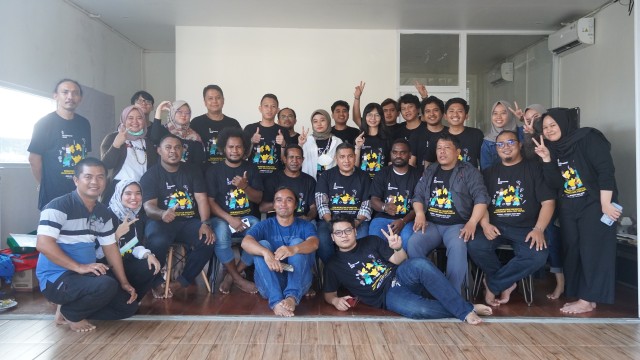
The inspection was held as a part of the Program for Capacity Enhancement and Collaboration of Law Enforcement in the Natural Resources and Environment Sector. As the implementing agency, Auriga Nusantara Foundation or Yayasan Auriga Nusantara was also present.
The program was enacted in response to recommendations from the National Movement to Save Natural Resources (GNP-SDA), a movement initiated in 2015 by KPK in cooperation with several ministries and agencies along with civil society elements. After compiling a list of problems in the governance of natural resources and the action plans to address them, KPK has determined that law enforcement in the natural resources sector needs to be strengthened to enhance the impact of existing efforts towards state revenue, restoration of the environment, and protection of the rights of the citizens living near the sites of natural resource-based businesses.
It took a three-hour trip for the team to arrive at the location of PT IWIP. At the entrance, a sign marked the site as a “National Vital Object”. The area was scattered with banners bearing messages in two languages: Indonesia and Mandarin. 10 percent of the 21,600 workers at the industrial estate are foreign citizens from China.
PT IWIP is a joint venture of three Chinese companies, Tsingshan, Huayou, and Zhenshi. Tsingshan is the majority shareholder (40 percent) through its subsidiary, Perlux Technology Co. Ltd., while Zhenshi and Huayou control 30 percent of the shares each. As the industrial estate is developed by foreign investment, its Industrial Estate Business Permit (IUKI) was obtained from the central government.


PT IWIP welcomed the KPK-led team warmly. The inspection was organized with a corruption prevention angle by the Directorate of Coordination and Supervision, Directorate of Monitoring, and Directorate of Fostering Networks Between Commissions and Institutions.
The warm reception was unlike what a similar inspection by the Regional Tax Office for North and Central Sulawesi, Gorontalo, and North Maluku had received before. “We were not allowed to enter the area beyond the entrance,” one of the tax inspectors, Nur Taqwa, recounted.
It was the same for the Ministry of Energy and Mineral Resources. The ministry lacks full authority in industrial estate areas, even if their business is related to the mining sector.
The inspection provided the team members sufficient opportunity to check on the industrial estate’s facilities from the port, thermal power station, smelter, up to the mining site. The company also agreed to requests to check on some license documents and to pay some dues.
The team achieved similar outcomes in a further inspection to PT Aneka Tambang (Antam) at Tanjung Buli, East Halmahera, the next day. The team had a discussion with the management of PT Antam and was also able to inspect the smelter and mining sites.
The discussions also inquired about regulation and policy-related hurdles the companies experienced in operating their businesses. With their strategic statuses, the KPK and the participating ministries and agencies could inform policymakers regarding those hurdles, while ensuring the principles of balance and proportionality.
The cooperation scheme proved to be conducive to the related ministries and agencies’ tasks in the natural resources and environment sector. Other than performing enforcement, KPK’s prevention function also enables it to act as an “anchor” that fasten together the strengths of the participating ministries and agencies against non-technical hurdles faced on the ground.
This form of cooperation is intended to be formalized with the creation of a natural resource and environment desk under the Coordinating Ministry for Political, Legal, and Security Affairs. The desk will bring together related ministries and agencies to integrate their monitoring and enforcement of natural resource and environmental law.