
Restoring the environment that has been damaged or polluted by corporate operations is a necessity, and following the enactment of Law No. 32 of 2009 on Environmental Protection and Management, law enforcers have increasingly incorporated environmental restoration in the prosecution of pollution and environmental damage cases. However, the implementation has not been smooth sailing. For instance, Meulaboh District Court’s ruling on the PT Kallista Alam case has yet to be executed, even though the ruling has been upheld as a permanent legal decision by the Supreme Court.
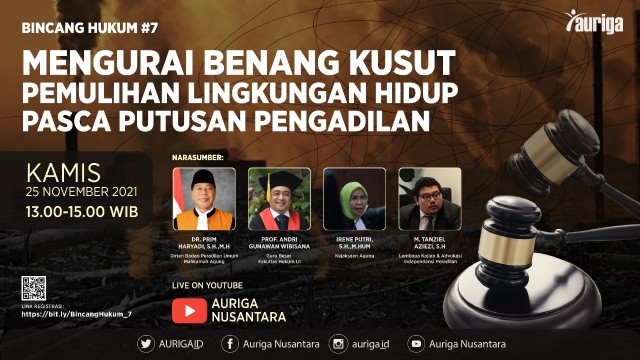
To disentangle the challenges to environmental restoration efforts, Auriga Nusantara held a webinar on the subject that was streamed on YouTube on Thursday, 25 November 2021. Hosted by Timer Manurung, the webinar featured Dr. Prim Haryadi, S.H., M.H. (Directorate General of General Court Body of the Supreme Court of Indonesia), Irene Putri, S.H., M.Hum. (Head of Sub-Directorate of Legal Acts & Legal Services Junior Attorney General Civil and State Administrative Division), Prof. Andri Gunawan Wibisana (professor of law at UI), dan M. Tanziel Aziezi, S.H. (Indonesian Institute for Independent Judiciary), as speakers.
Prim Haryadi began by stating that there have been only two cases involving environmental restoration that saw their court verdicts being executed. He further explained that there is yet to be a clear guideline for executing civil cases in the environmental sector. The existing guideline, Decree of the Chief Justice of the Supreme Court (SK KMA) No. 36.KMA.SK.II.2013, does not specify the execution mechanism, leading to a lack of uniformity in the implementation.
In addition, Prim Haryadi also detailed other hurdles to legal execution, including high costs; uncertainty regarding the duration needed for restoration efforts; confusion over who is responsible to oversee the execution; lack of understanding regarding restoration methods; resistance from the defendant; and the regulation specifying that compensations to environmental damages go to the state budget.
Closing his presentation, Prim Haryadi affirmed that addressing the problems requires participation from related institutions and experts in asset tracking and environmental restoration. There is also a need for judicial activism and a pro natura standpoint in enforcing the law in environmental cases to push for legal breakthroughs.
Irene complemented the previous presentation by highlighting how execution can fail in recovering assets. She asserted that this failure could be avoided by tracing the assets during investigation. She stressed the importance of asset recovery as crimes in the environment and forestry sectors could be motivated by economic interests, linking them to financial crimes such as corruption and money laundering.
Irene suggested that asset recovery could be pursued through both criminal and civil law means. For example, starting from a criminal charge, after the assets have been traced and recovered, the outcome of the tracing is incorporated into a civil lawsuit. In the PT Kallista Alam case, the criminal case verdict does not incorporate reparations and fines because they were thought to have been accommodated by the civil suit verdict. But since they are based on different paradigms, the fine could have been included in the verdict.
Next, Professor Andri Gunawan explained how strict liability for environmental restoration is put to practice in Indonesia. He asserted that in Indonesia, strict liability is still understood as a part of tort where the element of fault must be proven, even though strict liability imposes responsibility for the harm resulting from an activity without a finding of fault. While in the case of PT Kallista Alam, strict liability is understood as reversing the burden of proof to a fault. It means the defendant can still disprove the element of fault to be deemed not liable.
Regarding the execution of restoration efforts, Professor Andri put the spotlight on the Ministry of Environment and Forestry (KLHK), which is the government ministry bearing the responsibility of preventing pollution and restoring the environment. Thus, when the state has collected the compensation to environmental damages from the violator, it should be KLHK that put the compensation to use for restoring the damaged environment. But KLHK does not adhere to this paradigm, and it leads to the calculation of damages in lawsuits being based on the formula set out in the Ministerial Regulation rather than on the cost of restoration efforts, both underway and planned to be implemented. As a result, restoration does not get implemented after the compensation has been collected.
As the last speaker, M. Tanziel Aziezi proposed the most effective law enforcement option for restoring the environment. He believes that the civil, criminal, as well as administrative mechanisms for environmental law enforcement are already available and rigid. The court’s main role is to ensure that execution leads to effective restoration of the environment. On the administrative side, the mechanism for environmental restoration depends on the violator’s compliance, because instruments that can coerce the violator to comply have yet to be regulated under positive law.
With criminal law, the hurdle to restoration is the lack of coercive instruments to enforce it. Parallel criminal and civil suits could also be a problem because the civil law mechanism focuses on restoration, not on prison sentence and fine.
Considering the existing legal context in Indonesia, Aziezi recommended civil law as the most effective mechanism to press for restoration, because at least the execution process has already been defined in it.
Speakers and Presentations
Dr. Prim Haryadi, S.H., M.H. (Directorate General of General Court Body of the Supreme Court of Indonesia), “Hurdles to Executing Environmental Restoration”
Irene Putri, S.H., M.Hum (Attorney General Office Republic of Indonesia), “Optimising the Execution of Environmental Restoration Through Asset Tracking and Confiscation”
Prof. Andri Gunawan Wibisana (Guru Besar FH UI), dengan judul “Strict Liability Sebagai Upaya Perlindungan terhadap Lingkungan Hidup dan Pemulihan Kerusakan”
M. Tanziel Aziezi, S.H. (LeIP), “The Most Effective Law Enforcement Option for Environmental Restoration”
Time and Media
Date: Thursday, 25 November 2021
Time: 13.20-15.30
Media: Auriga Nusantara YouTube Channel